Followers

About Me

My photo
I wargame in 20mm, primarily using Command Decision 3, but have been tempted into other systems. I have a tendency to adapt CD to suit other periods with varied results! I take awful pictures and am at best an average modeller and painter, but hopefully quantity will have a quality all of its own.

Tuesday, 1 May 2012

WW2 Italians WIP

After the recent success of my Italians, I decided to create some additional elements to give them a better chance against Mr K.'s US forces. First off, I dragged out a nicely painted HO scale figure of  Mussolini from the Rocco Leaders set, and stuck it on a nice GW 20mm x 20mm base to give him some height.

Edit: Not painted by me - acquired painted second hand over 12 years ago.

While not strictly a fieldable unit, it does give me the option a nicely painted senior officer to use as a Command stand. Most likely though is that I will base it up and stick it in a box until I can display it safely (we still get the odd aftershock here, and the vibrations from the trains are significantly worst than before the earthquakes due to damage to the piles, still others have it much worse). While aspects of  Fascist Italy were better than in the Third Reich, it was still a totalitarian state that waged aggressive and expansionist wars, whilst repressing sections of its own citizenry. Had Mussolini survived the war, I believe that there is little doubt that he would of stood trial for warcrimes.

Next up are the Brixa 45mm Mortars. each Italian infantry battalion in CD is meant to have two stands of these. While other nations have 81mm mortar platoons organic to their battalions, the Italians have something somewhat less useful.

Metal Figures - I think by FAA. One stand is in the firing position, one stand showing the mortar on the move. The only game difference is aesthetic.

And the other side of each stand.

And the figures for four more stands.
Each infantry battion is also meant to have two MMG stands. Currently, I only have the four Breda M1937s from the Waterloo 1815 Folgore Division Light Artillery set, which have a gunner cast with the figure, and has the gunner in the paratrooper helmet. I plan to get hold of a few sets of the Waterloo 1815 Italian Infantry Support Group to acquire some more, but in the meantime I will make an attempt to scratch bulid a couple.
1/35 weapons often provide useful fiddly bits for scratch building.

And yet again a Bren may save the day.
As work progresses on these, I will post the results. I also will attempt to make some other infantry support weapons such as the various models of  Fiat-Revelli MMGs.

Of course I will need to provide my Italians with some anti aircraft defenses, so I glued onto a coaster mdf base a resin model of a Skoda7.5cm kanon PL vz.37, which was known in Italian service as the Cannone da 75/49, or even as the Cannone da 75/50 I have had this model for quite a few years, and as a result have no idea of its manufacturer.
Basing it will protect the fragile resin parts.

Enough room is on the base for the gun crew stand to placed right next to the gun.
Waterloo 1815 47mm Antitank gun. I need to make up multiple gun crews for these.

The only painted Italians I have at the moment are Esci Alpini that I acquired second hand based for WRG  and rebased for Cd. The uniform colour is a little too green for my liking, and the use of green for ammunition pouches - my understanding is that they were brown leather, black, grey, or grey/green. Still they did the job against Mr K.!

Command Infantry and Command stand. Nice Alpini figures with their black crow's feather.

Infantry stands. The LMG figures don't add an additional factor to the stand.

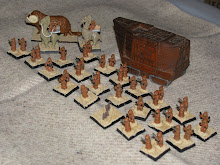
Pack mule stand. Every Italian infantry battalion has one pack mule stand in it's TOE.

The rest of the painted figures. Many of these were converted to normal infantry by having the Alpini feather trimmed off their helmets.
Unpainted Esci and Airfix Italians.

Unpainted Waterloo 1815 Italians.
Hopefully, I will be able to mix and match figure sets to build up some reasonable Italians for use in Spain, North Africa, Italy, and even the Eastern Front. The next post I do should be an AAR on last weekends Harad game.

Battle for St. Dominos Pt. 2.

The last post had my brave Italians withdrawing further into the woods after giving two of  Mr K.'s infantry companies a bloody nose. After their initial success, I felt it prudent to withdraw them before they received the attention of the US Heavy Weapons Company, or were outflanked by Mr. K's advancing infantry.
Outnumbered four to one, the brave platoon fell.
Visibility in the woods is 2".  Can't see the Italians? or the US? because them all look the same? Welcome to Mr K.'s world.... (Italians are group towards bottom left, the rest are US troops.)

This was where the US managed to gain their first success by catching the rearmost of the withdrawing Italian platoons and wiping it out. Its brave sacrifice allowed the rest of the company, and the battalion commander, to escape. The next turn saw the Americans advance further into the woods, while my brave Italian infantry moved out of the woods. closely followed by the US infantry. a brief firefight ensued, with the US getting the better end of it due to their superior firepower (the weapons platoons), and the support of the battalion mortar. the exchange was not all one sided though.

US Troops are bounced back into the woods from whence they came...

IWhile the italian troops take hits, and then would fail their morale...
And then came the Axis reinforcements! A full company of German Recon Armoured Cars - who as they are a different force will need to make all new spotting rolls for the US Infantry as they hide in the edge of the woods.
But I ordered Panthers......
Axis Reinforcements - Troop Quality: Veteran,  Morale: 10.
 German Scout Car Company w/
  1 Command  SdKfz 234/1
  2 Command  SdKfz 234/3
  1 Recon  SdKfz 234/1
  2 Recon  SdKfz 234/2s

The arrival of the Axis reinforcements allows Mr K. to dice for his reinforcements, and he rolls a 2. His reinforcements will arrive soon. In the meantime, I start to move my armoured force to deal with the Americans in the woods, and to protect the right flank of the monastery from an American advance in that direction. At this point I wishing for some more infantry and move my support stands into firing positions in a desperate attempt to increase the weight of fire from the monastery. In CD, if a Support stand is lost, a battalion gains a permanent -1 morale modifier, but with the Americans advancing I need the extra fire power.

The garrison awaits the onslaught of the US advance.
Fortunately more good news occurred when the company that had failed it's morale last turn decided to get back into the fight. They could only pass their morale on a 2 or less, so I was resigned to see them fail yet again, - perhaps even disastrously so - but they pleasantly surprised me.

A two Sir? Well ok!
This was to prove fortunate, as with the arrival of the US reinforcements, Mr K. was to become emboldened in his attempts to force a decision. After all, he now had a company of tanks to support his attack.

Shermans.... Where are my Panthers?!
US Reinforcements - Troop Quality: Experienced,  Morale: 8.
  Medium Tank Company w/
  1 Command  M4 (75)
  1 M4 (75)
  1 M4 (76)

The next US attempt to assault the monastery was made as his armour arrived on the table, and was a brutal attack by a full company of infantry, supported by his mortar platoon, on the flank of the monastery defended by the Italian infantry company that had been reinforced by the two support stands. Of course his attack had to cross open ground, which allowed the armoured cars to give supporting fire to the garrison.

Mr K.'s shame - His US troops were demoralised in their first encounter with Italians...

 The resulting encounter hurt me, but also resulted in the US company failing back, and failing its morale becoming demoralised. Of course soon the US armour was going to have a crack at things....

Shermans. Not a problem easily solved by my force.
The only good thing about their appearance near the monastery is that it allowed me to roll for further reinforcements, which would arrive in the next two turns. However, I had to survive the next two turns. This was going to be difficult.

The armoured cars get the worse of an exchange with the Shermans.
The armoured cars were able to hit the Shermans, but couldn't hurt them due to the range, their presence however made MR K. concentrate his efforts on dealing to them, rather than do further harm to the garrison, as he couldn't risk bringing his Shermans closer, nor risk sending infantry without the Shermans. The distance was also worked against him, as while he could destroy the armoured cars with his tanks, he first had to hit them - and the dice were against him that day.

The beleaguered garrison of St Dominos..
This was the point at which we decided to call it a day, as we had approached the end of our day of gaming. both of us were very happy with the way our ad hoc reinforcement mechanism had worked to gradually feed in additional troops into the battle, and both of us were impressed with how well the Italian infantry had performed - especially the plucky little company that just would not die!  as a result, I will be painting up some additional Italian forces for future games against Mr K. The game was judged a draw, with a tip of the hat towards the Axis, as we had reinforcements to come on table - (either a company of Panthers - which would have allowed US air support, or a company of Panzer Grenadiers in Halftracks) that could have tilted the game towards me more than Mr K. could cope with - I mean look at the trouble his boys were having with mere Italians...


Saturday, 28 April 2012

Thye battle of St Domino's Monastery Pt. I.


 Recently played a game of CD3 with a friend of mine, Mr K. the game was to be set in Italy in 1944, and was to be a small battle between a battalion of US infantry, and a battalion of RSI infantry. As the game progressed, each side would have access to small company sized groups of reinforcements. These reinforcements would take 1 to 3 turns to arrive (1d6, 1,2 = 1 turn, 3,4 = 2 turns, 5,6 = 3 turns.) This process would start with the first Axis encounter with the US forces, happen again when US forces encounter the Axis reinforcements, and so forth. we decided to do it this way because we wanted to try it out as a mechanism for feeding in new units into a game.

The kitchen table awaits....


We decided on a small setup of some roads, a woods, and a BUA consisting of the ruins of St Domino's Monastery. the Italian forces would be defending the area for a possible Allied advance.

Another view, this time towards the fridge.
The Italian forces consisted of a battalion of infantry, minus it's support company. The TOE was:

RSI Infantry Battalion - Troop Quality: Regular,  Morale: 7.
 HQ Company w/
  1 Command stand
  2 Support stands

3 Infantry Companies, each w/
   3 Infantry stands

The above TOE was based on the 1943 Italian Infantry battion TOE given in 'Armies of the Second World War' - note that the troop quality has increased one grade, and the morale has increased one point. My justification for this was  twofold, firstly for game balance, and secondly to reflect that, initially at least, RSI troops had 'better' morale and training under the German reorganization of Italian forces. With their usage as primarily anti partisan and garrison troops, morale did drop, and desertion did increase, so I would be reluctant to give those ratings across the board in 1944 - but for one small unit in a fictional battle, I am happy to do so.

Esci Italian pack Mules... surely you mean, Esci Italian Support Stands.

The first company deploys along the treeline.

Same company as above, but a different view. The Italian figures are all Esci, purchased second hand based up for WRG. They were then rebased for CD. The uniform colour is the same green shown on the old Esci box art, and is far too green - it should be more grey green. When these figures are repainted, when additional Italian forces are painted up, this mistake will be corrected.

The other two companies deploy in the Monastery.
 The US forces consisted of a full US Infantry Battalion, minus most of its motor transport, and having its 57mm gun replaced with an additional bazooka stand. As Mr K had never used these particular troops of these before (normally he uses US airborne troops), he elected to have them be troop quality regular.
His TOE was:

1944 US Infantry Battalion - Troop Quality: Regular, Morale: 8

Headquarters, w/

   1 Command stand
   1 Jeep

Headquarters Company w/

    1 Command stand
    1 Jeep
    2 Bazooka stands

3 Rifle Companies, w/

   1 Command stand
   1 Weapons stand
   3 Infantry stands

Heavy Weapons Company, w/

   1 Command stand
   1 Jeep
   1 81mm Mortar stand
   2 MMG stands

So to begin with, my forces were outnumbered, but I had two major advantages; firstly that I was defending, and secondly, that I would be receiving the first reinforcements.

US Heavy weapons Company started the game across from my deployment in the woods.

More US Infantry ready to advance.

US infantry ready to advance into the woods.
MR K deployed his troops and the game began with two US companies heading into the woods. These two companies were met with a hail of bullets from the Italian company in the woods. First blood to me.

Hit, forced back, and pinned!

And some more of the same!
Having temporarily blunted the US advance on one flank, I bravely decided to disengage back further into the woods. things for the brave Italian infantry company were about to get worse.....

Thursday, 26 April 2012

Sherman Firefly

 Most of this post is my musing on paint schemes. It's not an exciting topic, but I just wanted to record my thoughts somewhere that I would find difficult to lose, and could receive feedback on.  I have had discussions with Archduke Piccolo, and Ken, on this topic which have also shaped my musings. I've looked at TMP for info, and checked out Mike Starmer's thoughts on the MAFVA site, as well as checking out other sites, and of course looking at books!

As part of the British Tank Refurbishment project, I have been trying to figure out a paint scheme for my late war British and Commonwealth forces in the European Theatre of Operations. What I trying to do is minimise the amount of repainting I have to do, by using a combination of existing paintjobs, finding a simple repaint scheme for unpainted vehicles, and end up with a force that I can field in both Italy and North Western Europe. While I can always add in olive drab vehicles of American origin into a British force, (My understanding is that eventually Olive Drab was recognised as being an 'official' British paint scheme, to save American supplied vehicles from having to be repainted, but at the same time Olive Drab can also refer to a British colour that looks quite different.)
A selection of Matchbox Fireflies.
Same selection, different view.
Please note: I have only painted the last three tanks on the right, the two on the left were painted by other people. Starting from the middle, going left to right, we have a tank sprayed in FOW US Olive Drab, a tank sprayed with FOW late War British Armour, and washed with GW Devan mud, and the final tank in straight FOW Late War British Armour.

The two remaining tanks on the left, the dark one on the extreme left seems to be in a very late war scheme used in Germany by some Guards units ( please correct me if I am wrong - but I have only found one source for this in a colour plate in one of ken's books, and I'm not entirely convinced), while the one second from left is painted in a dark green colour - probably a Humbrol colour- that looks ok, but I'm not totally convinced with, but works well with the tank that has been sprayed with FOW Late War Armour, and then washed. The small numbers of vehicles I have in this colour will blend in well, if I use the spray and wash solution.

Both tanks have been spray painted with FOW Late War British Armour. the one on the left has also been given a wash of Devlan Mud.
Tank on left has been spray painted with FOW Olive Drab. Tank on right sprayed with FOW LWBA.
The two remaining tanks. Left: Dark Grey Green, and Right: Dark Browny Green.
So I am left with the conclusion that in order to get a paint scheme even roughly right for a British/Commonwealth force, I can use the FOW colour, with a wash as the base coat, and then figure out a disruptive colour, if any, from there. Of course, the usual caveats apply, and any mistakes are my own. It also appears that the colour of British tanks is quite a heated issue in some chunks of the internet, maybe it's not that boring a subject after all!

British Tank Reburbishment Pt. 2.

After spraying the tanks with some nice grey primer, it was time to go about adding missing hatches and tracks. Some of the resulting repairs were a little sub optimal due to shortages of parts.
Left track - an original Airfix rubber Sherman track. Right track - a mix of matchbox Firefly track, plastic strapping, and plastic card.

The Airfix track looks good!

The unholy mixture used to create the right track. Still, a coat of paint hides many sins.
While not the best of replacements, it does the job and looks better than the last resort of using plastic strapping to create both tracks. This has been the fate of more than one refurbished tank...
The replacement of missing turrethatches was to prove easier. I first roughly cut out a circle of about the right size and cut it in half. I then glued it down, and put a bit of card atop on hatch to act as vision block.

Precision craftsmanship at its finest..

This one was only half as difficult...
Given that these are quite world weary kits, I felt that  economy of  effort was justified in getting them up to a useable standard. My priority is to get as many fieldable tanks as possible onto the tabletop, and this current refurbishment reflects this philosophy.

An additional tank has been added to to this batch - a Matchbox Comet. When I was looking for track for Shermans, I discovered a gun from a Comet, so i quickly knocked up a very basic mantlet  out of plastic card, and glued it, and the gun into place.

A very basic mantlet.
I haven't replaced the missing rollers.

Another view.

Side by side with the first comet, which has been sprayed using FOW Late War British Armour.
After the missing bits are added (either pre or post priming), they are getting sprayed with the FOW Late War British Armour spray, and then getting either a black or brown wash. End result: more table ready tanks!