Followers

About Me

My photo
I wargame in 20mm, primarily using Command Decision 3, but have been tempted into other systems. I have a tendency to adapt CD to suit other periods with varied results! I take awful pictures and am at best an average modeller and painter, but hopefully quantity will have a quality all of its own.

Saturday, 12 November 2011

Haradian Irregulars

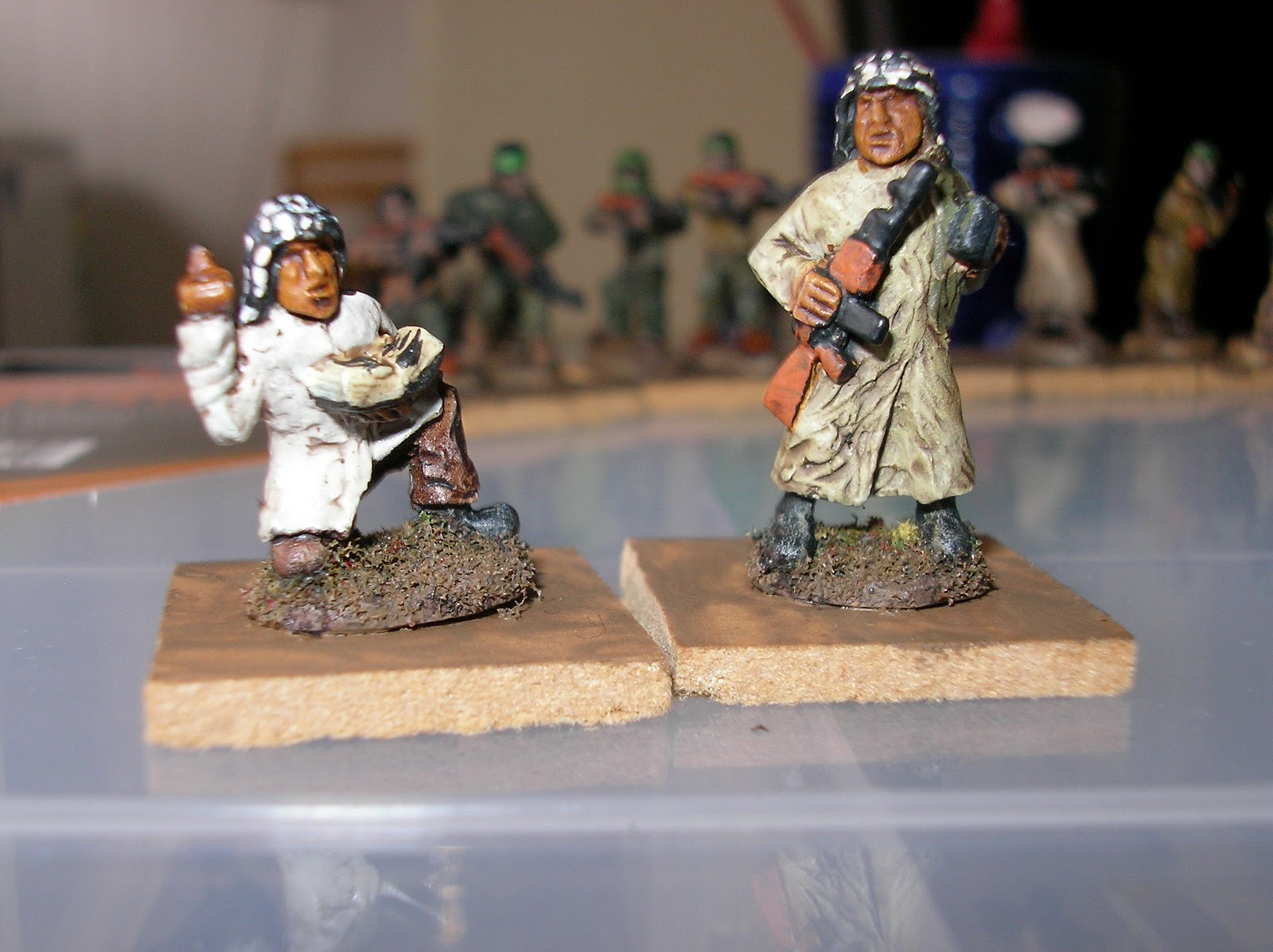
About six months ago I acquired ten metal 20mm Taliban of unknown manufacturer. Two of them had been painted, while the rest were just undercoated. looking at these figures I thought they would be perfect to recruit into a militia unit for use in Harad games.
Some friendly Haradis.

The local Mullah also acts as militia commander.
Two of these figures were areadly painted, so I just put them on 20mm bases and gave them a wash of GW Devlan Mud.
The Mullah (Command stand) and a Patrol Stand.

Another view of the same stands.
One of the house rules that my gaming group has is that of having snipers in CD. This came about as the result of a series of debates over the nature of what a stand represented, the nature of urban combat, the role of snipers, and if having snipers could result in more enjoyable games. Snipers under our house rules act like Anti Tank Assault stands (CD3 Rule 10.4), in that they are eliminated after just one hit, as they represent less than the normal minimum ten personnel required to be a single figure stand, and they only have their special form of attack. Sniper stands cannot be created during the course of a game. Snipers fire as per a normal stand with a ROF of one, but instead of a hit causing a hit on an enemy stand, it results in a pin. Depending on the scenario, this pin is either allocated by the target player amongst eligible target stands as per normal small arms hits, or for a more brutal game, the pin is allocated by the firing player.
Haradi Snipers, or if you prefer, Patrol Stands.
Naturally, all house rules are only used with the complete agreement of those playing.
Three platoons of militia. The GW Devlan Mud is becoming a favourite of mine.

I tried to give these guys the look of having access to some official form of supply with a mix of olive drab clothing items.

I like these guys, but they look like they need a Chieftain.
Since I have become more active in my posting, it has been a real pleasure to receive so much positive feedback on my work, so I would just like to say thank you to everybody who has started following this blog, commented on it, or just popped in for a look. Cheers!

Friday, 11 November 2011

Haradian Chieftains

As mentioned in a previous post, one of the backgrounds my gaming group uses for moderns is Harad. Harad is a troubled land, with many armed factions seeking to gain control of the country. One of these factions is the Army of the People's Islamic Republic of Harad. Like many groups in Harad, it's equipment ranges from elements of the old Imperial Army, ex Warpact equipment, purchases on the open market, and finally local production of various utility. The Chieftain models are plastic knock offs of the Matchbox Battle Kings Chieftain.


Tanks and spray can of primer.


Missing gun is replaced by sprue.

The hole on the Matchbox original has been blanked out on the casting that produced this knock off.

 While many factors possess Chieftains from the old Imperial Army (purchased at a time that the West was friendly to Harad, and the UK keen to sell arms for oil money), many of the tanks purchased are suffering from a lack of love maintenance. In order to simulate this, the breakdown number mechanic, has been adapted from GDW's Over the Top. Simply put, a vehicle is given a number from 1-10 that it must roll higher than in order to a) take part in the scenario, and/or b) roll whenever it wishes to move. Rolls are modified by crew quality. Naturally failure results in a breakdown and either no appearance in the scenario, or a lack of further movement.

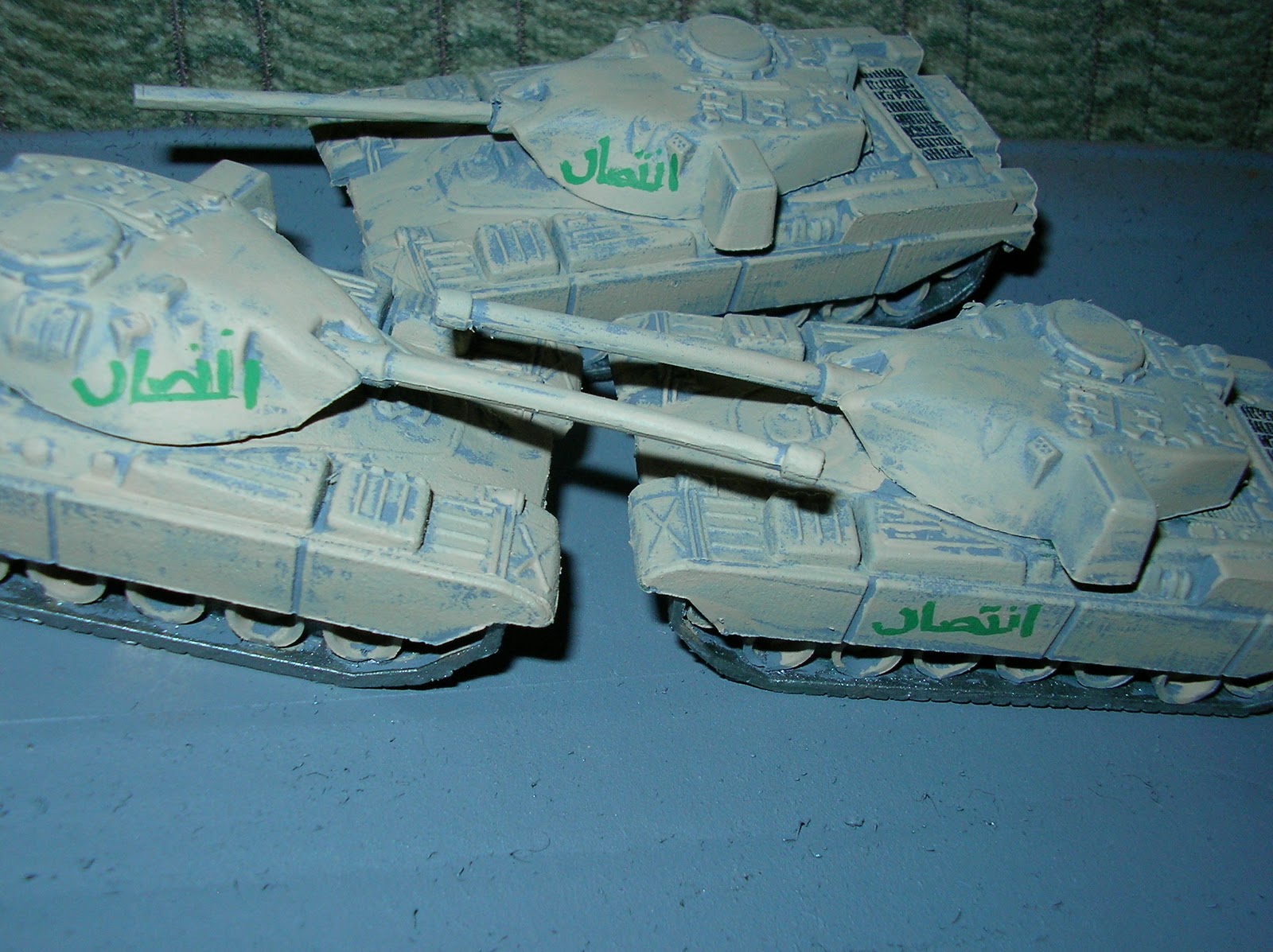
Iraqi Sand is painted over the grey primer.

Suitable slogans are dabbed on the tanks in Arabic. The middle tank's is meant to be 'People's Jihad'. Between Google Translator and my painting it's probably reads as 'Green squiggle'


This could mean victory, but I bet it's just a nice looking squiggle.

Another view of the Chieftains. The road wheels are completely wrong, but the tanks were free.

Look! Flank Armour!
Victory on all three tanks.

All in all, a cheap and simple way to boost tank numbers. While not the most accurate of Chieftain models, these have the over riding virtue of being free, and available in reasonable numbers. I am toying with a way of making the plastic trucks that you used to get with the bags of Hong Kong knock offs usable in a simple and effective manner, as the post war cab body would be perfect for use throughout the third world. My basic idea is to add rear wheel arches, a cab floor of some type, and possibly change the wheels or thicken them up in some way. If I can figure this out, I will be able to increase the motorpool by dozens of vehicles.

Wednesday, 9 November 2011

Japanese Pt. 3

These Japanese mounted stands came about as a result of me wanting to create some mounted Command stands, FO/Spotter stands, and Patrol stands for my Japanese. The inspiration for this came about from seeing a photo of a mounted officer leading his troops marching through China in the 1930s. So I looked through my bits box for spare Airfix and Esic horses and started to build some up. Various Airfix, Esci, and Hong Kong knockoffs were cut up and combined to create the riders. Naturally, the saddles and tack is completely wrong, and red saddle cloths are a product of my imagination. Actual research suggests a natural/tan colour when on was used. However, red does go faster  look good and give a uniform appearance to the nags!

None of these guys are Baron Nishi. 
Being able to have some variety in my Command stands has been a mixed blessing, as having Command, Spotter, and Patrol stands mounted tends to gain unwanted attention.
Blurry horses, well focused Italeri box. Sigh...
That's better! I find painting dark brown on a undercoat of black makes a nice horse. Plus it goes well with the red.

Sword waving stands tend to used more as patrol stands. The figure on far right is the mounted officer from Airfix Series 2 French Foreign Legion set. He has been remounted on an Esci horse and was painted up at the same time. 
One thing every Japanese WW2 army needs is bicycle mounted troops. I made mine by using Airfix bicycles, metal bicycles from unknown manufacturer that I acquired second hand, and my favourite Hong Kong knock off pose.
Gasp! A genuine Airfix soldier in the line up!

The metal ones are much larger.
Each one of these stands represents a platoon of infantry that has acquired bicycles by fair means or foul. While Japanese troops were issued bicycles (6000 per division according to Tsuji), they also used impressed civilan models for parts and replacements. Bicycle mounted troops were used in some Cavalry regiments as a reconnaissance element due to a shortage of horses. Infantry units during the Malaya campaign used bicycles to help speed their advance towards Singapore, but bicycles were used extensively in other theatres too.

Tuesday, 8 November 2011

Japanese Pt. 2

Leva Products used to make a set of resin 1/72 Japanese Infantry Equipment. This set contained lots of fiddly little resin bits that could be added to figures to make specialists, or to just jazz things up a bit. To add to the fun, none of the equipment was identified or came with assemble instructions.

Some Esci Japanese Infantry. The one on the right has gotten a resin Type 100 flamethrower.
As having flamethrower equipped stands are often useful in CD, I based these guys up as a stand of engineers that could be attached as needed.

The rear view showing the distinctive three cylinders of the Type 100.  
The infantry weapons set also included a Type 97 20mm Anti Tank Rifle. The Type 97 has both AP and HE rounds, so the CD3 stats of not letting Type 97 stands fire on infantry  is wrong. My house rule is either to give it a 'P', or a 'P+1' rating, to reflect actual usage. As with all house rules this is subject to negotiation, thus there being two 'P' ratings.
Gunner is a converted Matchbox Japanese Infantryman.
Number Two is a Esci Japanese Infantryman.
Leva also included two Model 93 13mm Machine Guns. One of mine is currently awaiting repairs, and the remaining one has not yet been fitted out with crew.
This stand has got its P+1 rating, but is sadly lacking a crew.
One of the real gems in the set is the Model 94 90mm Mortar. 

Model 94 Mortars. Crew are (left to right) Hong Kong knock off, Esci, Unknown, Airfix.

Rear view of same, the mounted stands behind are for another day.
Also included in the set are some Model 11 37mm Infantry Guns. I enjoy fielding these as they add more variety into a force.
Model 11 37mm Infantry Guns. Crews are a mix of the usual suspects.
Under CD, the Japanese have a great deal of manpacked support weapons, which allows them to move rapidly into position on wargames tables with vehicle  unfriendly terrain.


Monday, 7 November 2011

The Imperial Japanese Army Pt. 1

One of my favorite CD armies is my WW2 Imperial Japanese. I have acquired a number of bits and pieces over the years, including Evan's Japanese based up for WRG. Logistics is an area which is often glossed over in wargaming, so for my Japanese I thought I would made some logistics units. Japanese logistics during WW2 was more dependent on supply from local sources than the other major combatants, it was also less motorised. 
Japanese Pack mules. Most are from the Airfix German Mountain Troops pack, with an added Hong Kong knock off on the stand. Some are from the most excellent Airfix Jungle Outpost set. One is a model railways pony with milliput and a Airfix Japanese Infantryman. And, yes one is an elephant...

Breakfast Cereal Elephant + Fimo = Cargo Elephant for use in Burma.

During WW2 the Japanese made use of captured Allied vehicles. This gave me the excuse to rebuild vehicles from the scrap yard and give them to the Japanese to use.
Two rebuilt Matchbox Chevy LRDG trucks. I tried to make the rebuild similar to pictures of trucks abandoned along the Burma road.

Another view of the same.

Rescued from the scrapyard, a part melted Airfix Attack force Quad, pressed into Imperial service.

This side had a large melted hole which is now covered by a piece of plastic card and a pick axe.
Of course, not all the transport used by Japanese is so preloved.
Hasegawa Trucks: The Aircraft Tender and the Tanker Truck.

Another view of the Tender Truck.

Unknown Metal Fords/ GAZs. Given the awful nature of the castings I suspect they are knockoffs. I purchased these as assembled kits from someone using them for a Polish Army. The Model A sure got around.

More of the same. A Hasegawa GMC canvas cover has been cut down for one.
At some stage a major rebuilding and repainting effort is going to happen to my Japanese. Ideally the trucks will end up being painted in the same colour scheme, and the Chevys will be reworked into ex Dutch vehicles. Model A Fords could either be ones produced by the Ford plant in Yokohama or war captures. Further research into this will need to be done.
Pack horses for my Japanese 75mm Guns. 15mm ACW artillery wheels, model railway horses, and Hong Kong knock offs.

A reworking of the limber from the Airfix Civil War Artillery set.

Another view of the limber. Passenger on the limber is a Hasegawa driver.
The pack horses are for the Type 41 75mm Mountain guns my Japanese use. I have a number of ones from the Fujimi Japanese Infantry set - along with lots of rather useless figures!

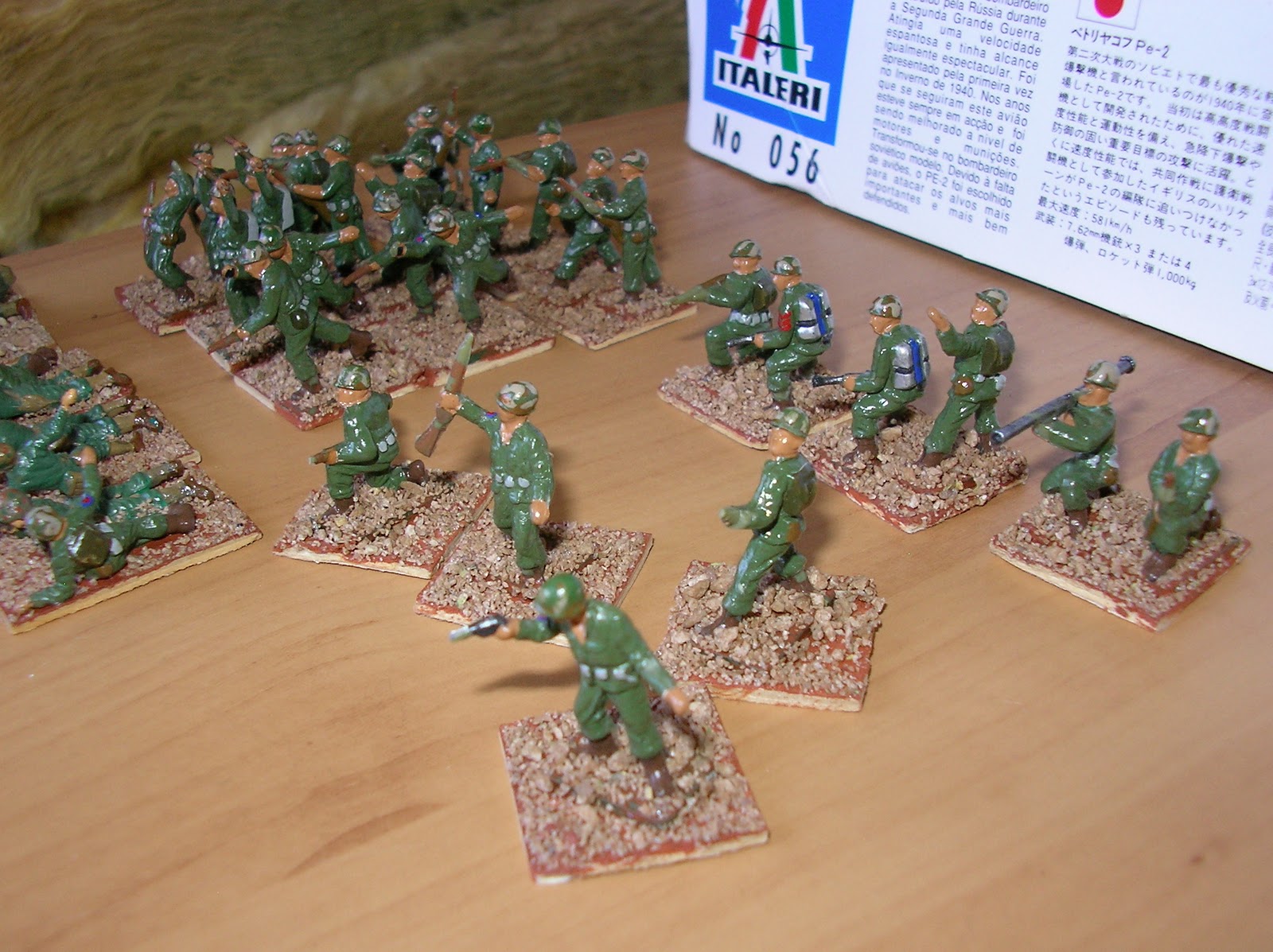
Series One Airfix US Marines

Many years ago I purchased a large number of prepainted Airfix soldiers that included some rather nice Series One Airfix US Marines. Naturally, I then based them up to use as a 1944 USMC battalion. I rather like these figures.
Some flaky paint but otherwise ready for action.
They were short a few figures such as machine guns, and a mortar team, so a few 20mm Hong Kong knock offs of the Airfix Series 2 Marines, plus a genuine one two, and the Esci Mortar Team from the US soldiers 'Big Red One' set. I think the paint jobs fit in well with the originals.
Why didn't they give us  the 1/32  Officer figure poses.

Another view of the additional figures.
These guys serve as either MG stands or Weapons stands. The .30 cal should be a tripod mount rather than the lmg bipod alternate standard to the BAR, but hey, no one has pinged me yet for the error.... Oh, wait...
Looking through these guys reminds me of all the fun Iwo Pasifika games I have had with them. They need some touching up where the original enamel paint has flaked off, and the mg and weapons stands redone. Still, thats all part of the fun because no wargames army is every truly finished. When I start painting up the huge pile of Marines in the stash is when I will start looking at redoing these guys.

Sunday, 6 November 2011

Landing Craft

Back in around 2001/2002 I wanted to run some games involving amphibious operations in the Pacific. In order to do so I had to acquire landing craft - in particular LCVPs. Since at the time there wasn't any easily available in NZ, I decided to scratch build some. The basis for my scratchbuild was a plan from a guy on the old rec.mininatures,historical newsgroup (or something like that), which I lengthened and modified by putting in guntubs and some crew.
Cardboard LCVPs.
The parts were then cut out of cardboard in slow periods on night shifts, and assembled in batches on days off shift. As I needed quite a few of these, the idea was to create a model that could take four infantry stands (In CD each model represents aprox. four real LCVPs each of which could carry around a platoons worth of troops or one light vehicle). In addition the model had to be cheap to make, and easy to produce. Detail was deliberately sacrificed in order to produce 20 models in a short period of time. The idea was to produce 48 models as suggested in a CP as what should be available for each USMC Division landing, but was scaled back for reasons of sanity.
Nearly a decade later and still in good shape.
 The part of the project was to give each LCVP a coxswain, two .30 cal, machine guns, and two gunners. Not all of the LCVPs received these as I wasn't entirely happy with the ones I had done.
The only one which got gunners and a coxswain. The cardboard shield need redoing.
The basic premise of quantity having a quality all of its own has been proven quite successfully by these craft, as they have made appearances on more than my own games, having been borrowed for a few Normandy games, in addition to my own games and my large Tarawa mega game of CD.
Another view showing how the rear has been squared off for easy construction.
The simple interior makes it easy to put stands in and out.

I also tried making a simple scratch built cardboard LCA. I based my model off a resin one (maker unknown) I bought at a bring and buy at the Irish Society Hall in Christchurch.
The first and only effort. Difficult to make.
This project was shelved as I came to the conclusion that the effort put in to this project could be better spent on others. However, I have always wanted more than two LCAs...
Another view. Detail adds complexity, complexity requires effort.
The major flaw on the LCA is that the 'V' shape at the rear should be pointing to the back and not the front as I have it. This is only a minor flaw and has never been pointed out to me by others, perhaps out of kindness. I however noticed just after I painted it, and it still bugs me. Should I make more, this will get fixed.